Search engine optimization has changed dramatically over the last decade. What once worked—keyword stuffing, spammy backlinks, and thin content—can now actively harm your rankings. Yet one debate still confuses marketers, founders, and creators alike:
On-Page SEO vs Off-Page SEO — which actually impacts rankings more?
Some say content is king.
Others swear backlinks are everything.
The truth? Google doesn’t rank pages based on one factor—it ranks trust, relevance, and usefulness.
In this guide, we’ll break down:
- What On-Page SEO really means today
- What Off-Page SEO actually signals to Google
- The key differences between the two
- How each impacts rankings
- Real-world examples
- And finally… which one is better?
What Is SEO (In Simple Terms)?
SEO is the process of helping search engines understand, trust, and rank your content for the right queries.
Google’s job is simple:
Show the most helpful, trustworthy result for every search.
Your job?
Prove that your page deserves to be that result.
SEO is divided into three major pillars:
- On-Page SEO – What’s on your website
- Off-Page SEO – What others say about your website
- Technical SEO – How well your site works (speed, crawlability, etc.)
This article focuses on the first two—the most debated and misunderstood.
What Is On-Page SEO?
On-Page SEO includes everything you control directly on your website to improve rankings.
Think of it as making your page clear, useful, and relevant for both users and search engines.
Core Elements of On-Page SEO
1. Content Quality & Depth
Modern SEO starts and ends with content.
Google evaluates:
- Does this page fully answer the search intent?
- Is the content original and helpful?
- Is it written for humans, not algorithms?
Thin content doesn’t rank anymore.
Top-ranking pages are long, structured, and genuinely useful.
2. Keyword Optimization (Not Stuffing)
Keywords still matter—but context matters more.
Best practices:
- Primary keyword in title, URL, first 100 words
- Natural variations (LSI / semantic keywords)
- No forced repetition
Google understands meaning, not just words.
3. Title Tags & Meta Descriptions
Your title tag is still one of the strongest on-page ranking signals.
A strong title:
- Matches search intent
- Includes the primary keyword
- Encourages clicks (CTR matters)
Meta descriptions don’t directly affect rankings, but they influence click-through rates, which indirectly affects performance.
4. Headings (H1, H2, H3)
Headings help:
- Users scan content easily
- Google understand content structure
A clean hierarchy improves readability and relevance.
5. Internal Linking
Internal links:
- Distribute authority across pages
- Help Google crawl your site
- Improve time on site
Pages that are well-internally linked tend to rank better.
6. URL Structure
SEO-friendly URLs are:
- Short
- Descriptive
- Keyword-focused
Bad: example.com/p=123
Good: example.com/on-page-seo-guide
7. User Experience (UX)
Google tracks behavior signals like:
- Bounce rate
- Time on page
- Scroll depth
If users leave quickly, Google assumes the page wasn’t helpful.
8. Image Optimization
Optimized images:
- Improve load speed
- Appear in image search
- Enhance accessibility
Includes alt text, compression, and proper sizing.
What Is Off-Page SEO?
Off-Page SEO refers to everything that happens outside your website that affects rankings.
In simple terms:
It’s about reputation, authority, and trust.
Google wants proof that others value your content, not just that you think it’s good.
Core Elements of Off-Page SEO
1. Backlinks (The Biggest Factor)
Backlinks are still one of Google’s top ranking signals.
But not all links are equal.
Google evaluates:
- Authority of the linking site
- Relevance of the linking page
- Natural link placement
- Anchor text diversity
One strong link from a trusted site can outweigh 100 low-quality links.
2. Brand Mentions
Even unlinked mentions of your brand:
- Build trust
- Improve entity recognition
- Strengthen topical authority
Google increasingly treats brands as entities, not just websites.
3. Digital PR
Modern link building = earning links through credibility.
This includes:
- Media features
- Thought leadership
- Data-driven content
- Expert quotes
This is why Digital PR has replaced old-school link building.
4. Social Signals (Indirect Impact)
Social shares don’t directly boost rankings, but they:
- Increase visibility
- Attract natural backlinks
- Drive traffic
More exposure = more chances to earn authority.
5. Reviews & Trust Signals
For local and service businesses:
- Google reviews
- Business listings
- Reputation signals
These heavily influence local SEO rankings.
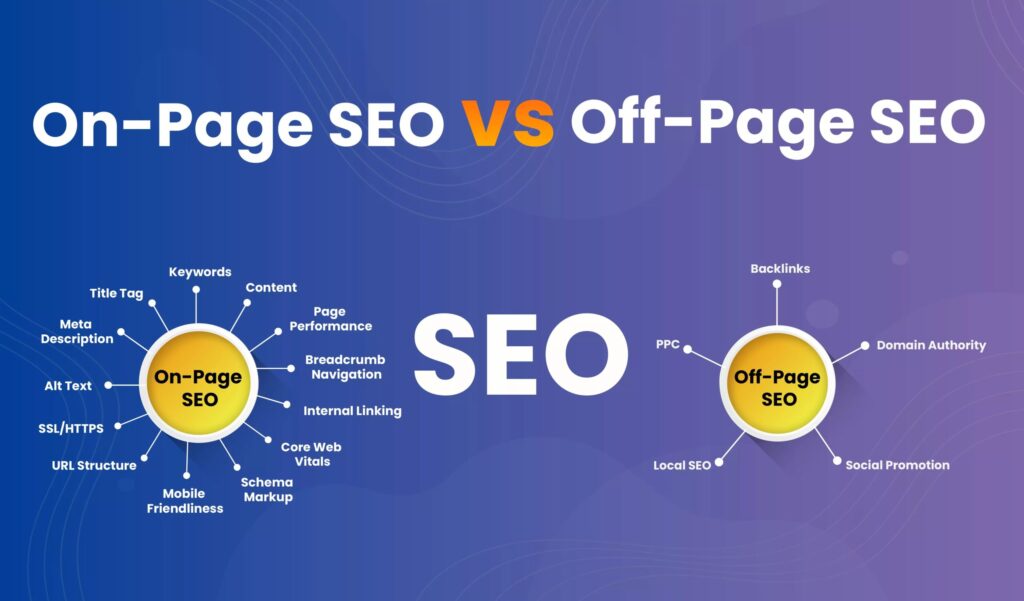
On-Page SEO vs Off-Page SEO: Key Differences
| Factor | On-Page SEO | Off-Page SEO |
|---|---|---|
| Control | Fully under your control | Depends on others |
| Focus | Content & relevance | Authority & trust |
| Speed of impact | Faster | Slower but stronger |
| Cost | Mostly time & effort | Often resource-intensive |
| Long-term value | Foundational | Compounding |
| Risk | Low | High if spammy |
How On-Page SEO Impacts Rankings
On-page SEO answers Google’s first question:
Is this page relevant and useful?
Without strong on-page SEO:
- Backlinks won’t help much
- Rankings won’t stick
- Users won’t convert
On-page SEO:
- Helps you rank for the right keywords
- Improves dwell time
- Reduces bounce rates
- Builds topical authority
No amount of backlinks can save bad content.
How Off-Page SEO Impacts Rankings
Off-page SEO answers Google’s second question:
Can this page be trusted?
Two pages may have equally good content—but the one with stronger authority usually wins.
Off-page SEO:
- Pushes competitive keywords into top positions
- Helps outrank established competitors
- Strengthens domain authority
- Protects rankings long-term
In competitive niches, off-page SEO is the deciding factor.
Real-World Example
Scenario 1: Strong On-Page, Weak Off-Page
- Excellent content
- Perfect keyword optimization
- No backlinks
Result:
- Ranks for low-competition keywords
- Struggles to break top 10 for competitive terms
Scenario 2: Weak On-Page, Strong Off-Page
- Many backlinks
- Poor content
- Bad UX
Result:
- Temporary rankings
- High bounce rates
- Eventually drops
Scenario 3: Strong On-Page + Strong Off-Page
- Helpful, in-depth content
- Clean UX
- High-quality backlinks
Result:
Stable top rankings
Long-term traffic
Higher conversions
Common Myths About On-Page and Off-Page SEO
Myth 1: “Backlinks Are Everything”
False. Backlinks amplify content—they don’t replace it.
Myth 2: “On-Page SEO Is Enough”
Only for low-competition niches.
Myth 3: “SEO Is Just Keywords”
SEO today is about intent, trust, and experience.
Myth 4: “More Links = Better Rankings”
Quality beats quantity—always.
Which Is Better: On-Page SEO or Off-Page SEO?
Here’s the honest answer:
Neither is better alone.
But if you force a choice:
On-Page SEO Comes First
Because:
- Without it, off-page efforts are wasted
- It defines relevance
- It improves user satisfaction
- It builds topical authority
Off-Page SEO Comes Second (But Wins Competitively)
Because:
- It decides who ranks #1 vs #5
- It builds trust Google can’t ignore
- It protects rankings long-term
Final Verdict:
On-Page SEO is the foundation.
Off-Page SEO is the multiplier.You cannot skip either if you want sustainable rankings.
The Smart SEO Strategy in 2026
- Start with exceptional on-page SEO
- Build content clusters, not single pages
- Optimize for users first, algorithms second
- Use Digital PR, not spammy link building
- Build a real brand, not just a website
SEO is no longer about gaming Google.
It’s about earning trust at scale.
Final Thoughts
If you’re serious about rankings:
- Stop choosing sides
- Stop chasing hacks
- Start building value
Because in modern SEO, the sites that win are the ones people trust—and Google simply follows the crowd.